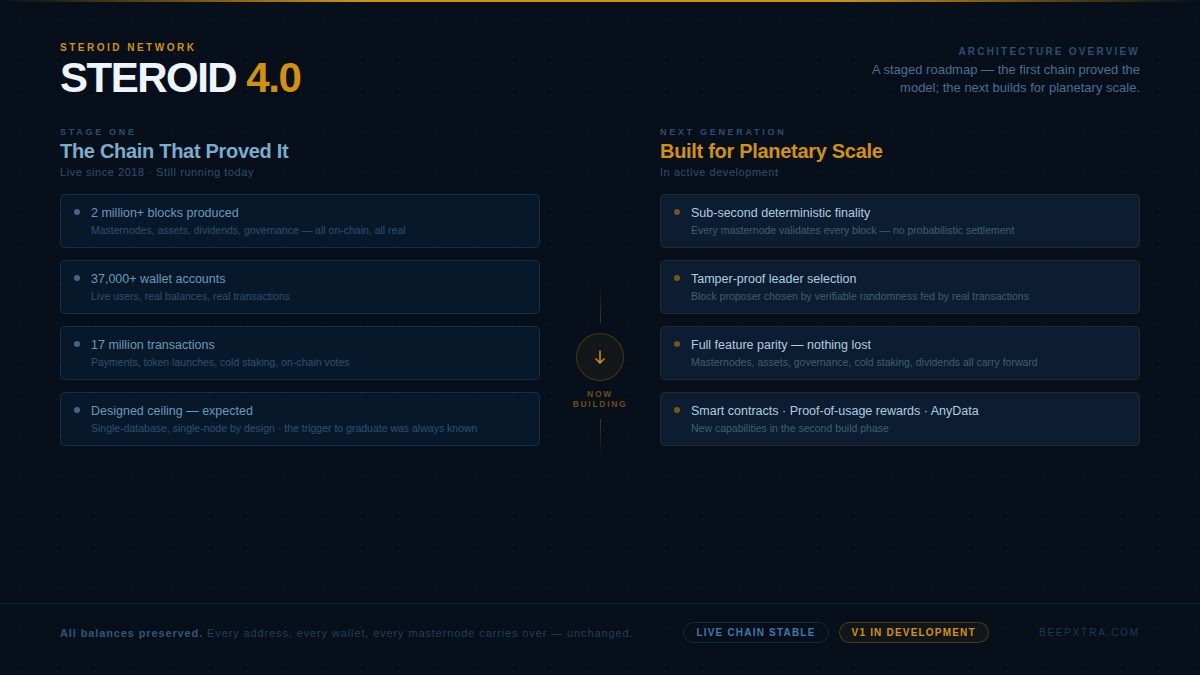
Steroid 4.0: The Upgrade That Was Always in the Plan
Steroid's staged roadmap was set in 2018 — prove the model first, then build for planetary scale. The first chain did its job. The next-generation core is now being built.
Steroid was never a single-step project. The plan was deliberate from the start: develop a first-stage chain, run it through years of internal testing as a proprietary network, then launch publicly and prove the retail payments model in production — before graduating to a purpose-built, high-performance core once that chain approached its known limits. That moment has arrived. This post explains what we built, what we are building now, and why.
What We Built
A chain that proved the model
The first Steroid chain took its first public breath on 9 March 2022 — the date of the public genesis block. Developed from 2018 and tested internally as a proprietary network before that, it has since processed Over that time it has processed 17 million transactions, produced over 2 million blocks, and grown to more than 37,000 wallet accounts. It runs masternodes, on-chain governance, cold staking, dividends, and a full token/asset layer — all of it real, all of it live, all of it battle-tested. BeepXtra is its first and primary use case, and the network has validated the retail payments model exactly as intended.
A designed ceiling — expected from day one
The first chain was built for fast, reliable launch and correctness, not for world-scale throughput. That was a deliberate choice, not a flaw. A single-database design is straightforward to operate and easy to reason about — ideal for bootstrapping a network. Its limits were known from the start, and approaching those limits was always the planned trigger to build the next stage. We are at that trigger.
What We Are Building
Instant, deterministic finality
The current chain settles transactions probabilistically — like most first-generation chains, you wait for enough blocks to be confident a transaction is final. The new core settles in under a second, with certainty. Every masternode participates in validating every block, and finality is mathematically guaranteed by the time the block is committed. For retail payments at the point of sale, this is the difference between "probably done" and "done."
Tamper-proof leader selection
In the new core, the masternode that proposes each block is chosen by a verifiable random function — a cryptographic mechanism that is unpredictable, manipulation-resistant, and publicly verifiable. The randomness is continuously renewed by real transaction activity on the network itself. No one can predict or influence who produces the next block.
Built to scale — one chain first
Throughput comes from parallel execution — transactions touching different accounts run concurrently, not in a queue. The goal is a single high-throughput chain that serves global retail volume. Splitting the chain into pieces is a last resort, considered only if one chain is genuinely saturated at scale.
Native payment accounting
The new chain introduces total / available / locked balance accounting at the protocol level. When a payment is made, the amount is locked at the moment the transaction is accepted and settled atomically on finality. No double-spend risk, no optimistic state — the balance mechanics match what retail actually needs.
What Carries Over — Everything
Your wallet address is yours, forever
Every wallet address on the current chain carries to the new chain unchanged. No re-registration. No new keys. No lost history. The same address format, derived the same way, from the same keys — continuity by design.
Every balance, masternode, and asset
The migration takes a complete snapshot of the live chain — every balance, every masternode, every governance record, every asset, every alias — and carries it forward into the new genesis, verified balance-for-balance before the switch is flipped. Nothing is lost.
Existing wallets and integrations keep working
The new core ships a full API compatibility layer mirroring the current endpoint surface. BeepWallet, block explorers, merchant integrations, and the existing SDK keep working through the migration without any changes on their end. The cutover is invisible to users.
What Is Coming Next
Phase one — payments core
The first release of the new chain delivers transfers, fees, the full masternode validator set with verifiable random leader selection, on-chain governance, and the state migration from the live chain. A real, usable, migratable network.
Phase two — the full feature set
The second phase brings permissionless token launch (any wallet can create a token, fund a per-token fee pool so holders don't need the base coin to transact, and declare optional parameters like dividends or fixed pricing), smart contracts, on-chain data storage with an anti-bloat design, and proof-of-usage rewards — a native mechanism that rewards genuine network activity, funded by merchants, unprofitable to game by construction.
Phase three — only if needed
If a single chain reaches genuine saturation at global scale, account-space sharding is the planned path. It is not a default — it is the last resort, and it will only be built if the evidence demands it.
The live chain continues running normally throughout development. Nothing changes for operators or users until the cutover is authorized and confirmed.
Follow the progress
Steroid4.0 code repository is public and everyone can follow the work being done, or contribute at the GitHub repository Steroid4.0 Code - LARS/Rebuild branch.
Questions? Reach out to the team.